


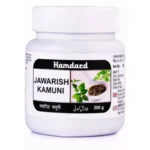

Hamdard Jawarish Kamuni
Price range: ₹85.00 through ₹415.00
Hamdard Jawarish Kamuni is a classical Unani paste of caraway (soaked in vinegar and roasted), rue leaf, ginger, black pepper and Armenian bole in honey and sugar. In Unani medicine it is traditionally taken after meals to support digestion. Label dose: 5 to 10 g after lunch and dinner.
- Packs: 150 g, 300 g, 500 g, 1 kg
- Dose: 5 to 10 g after meals
- Caution: not in pregnancy, for babies or with diabetes
Hamdard Jawarish Kamuni is a sweet, spiced Unani paste built on caraway seed that has been soaked in vinegar and then roasted. Its other ingredients are rue leaf, ginger, black pepper and Armenian bole, set in honey and sugar. In Unani medicine it is traditionally taken after meals to support digestion. The label dose is 5 to 10 g after lunch and dinner. We stock it in 150 g, 300 g, 500 g and 1 kg jars.
On this page
What is Hamdard Jawarish Kamuni?
Hamdard Jawarish Kamuni is a jawarish, a Unani digestive paste that is coarser and more spiced than a majun. The name comes from kamoon, the Arabic word for cumin, because a cumin-family seed leads the recipe. New to these pastes? Our guide to majun and similar Unani pastes explains how they are made. This jar is made by Hamdard Laboratories (India) at its Ghaziabad unit.
| Brand | Hamdard Laboratories (India) |
| Made at | Ghaziabad, Uttar Pradesh; marketed from New Delhi |
| Form | Jawarish (spiced paste in honey and sugar) |
| Packs | 150 g, 300 g, 500 g and 1 kg jars |
| Main ingredients | Caraway, rue leaf, ginger, black pepper, Armenian bole |
| Label dose | 5 to 10 g after lunch and dinner |
| System | Classical Unani formula |
| Licence and shelf life | Printed on your jar |
What is Jawarish Kamuni traditionally used for?
In Unani medicine, Hamdard Jawarish Kamuni is classed as a warming digestive that you take after food. The maker’s label lists stomach ache, gas and bloating, weak digestion, hiccups, acidity and constipation. In Unani theory, warm seeds such as caraway and pepper are given when digestion feels slow or "cold". Think of it as support for an occasional upset tummy, not a treatment for any disease. Belly pain that keeps coming back needs a doctor, not a bigger dose.
What are the Hamdard Jawarish Kamuni ingredients?
The current Hamdard label lists five active items in a honey and sugar base. Exact amounts are printed on each jar.
| Unani name | Common or botanical name | Part and note |
|---|---|---|
| Zeera siyah mudabbar biryan | Caraway (Carum carvi) | Seed, soaked in vinegar and roasted |
| Barg-e-sudab | Rue (Ruta graveolens) | Leaf |
| Zanjabeel | Ginger (Zingiber officinale) | Dried root |
| Filfil siyah | Black pepper (Piper nigrum) | Fruit |
| Bura armani | Armenian bole | Red mineral clay, not a plant |
| Shahad and qand | Honey and sugar | Sweet base |
Two items surprise many buyers. Bura armani is a mineral clay, and rue is a strong-smelling leaf that pregnant women must avoid. Some older listings, including our own earlier page, also named cinnamon, clove and mastic. Those belong to other jawarish recipes, so trust the label on your jar.
How do you take Hamdard Jawarish Kamuni?
The label dose is 5 to 10 g after lunch and dinner, or as your physician advises.
| Who | How much | When | With what |
|---|---|---|---|
| Adults | 5 g to start; up to 10 g | After lunch and dinner | On its own or with lukewarm water |
| Children over 1 year | Only if a physician advises | As advised | As advised |
| Babies under 1 year and pregnant women | Do not use | Not applicable | Not applicable |
Pharmacist’s tip: a level teaspoon of this paste weighs about 5 g. Use a dry spoon every time, because water in the jar can spoil a honey paste. If it turns hard in winter, stand the closed jar in warm water for a few minutes.
Who should not take Hamdard Jawarish Kamuni?
- Pregnant women, because rue leaf has long been used to bring on periods. Ask your doctor while breastfeeding too.
- Babies under one year, because the base contains honey.
- People with diabetes, since honey and sugar make up most of each spoonful.
- People with stomach ulcers or strong acid reflux, as pepper and ginger can make burning worse.
- Anyone on blood thinners or several daily medicines, who should ask a doctor first.
Side effects are usually mild, such as a warm or burning feeling in the stomach or loose stools at higher doses. Stop and see a doctor if you vomit blood, pass black stools, lose weight without trying, or have belly pain for more than two weeks. Before you open a new jar, check the seal and batch details, and use our checklist for genuine Unani medicine.
Is it the same as Jawarish Kamooni Kabir or Mushil?
No, these are three separate Unani recipes that share one name. Kabir or Akbar means larger, and those jars list more herbs. Mushil means laxative, and that version adds purging herbs. This page covers only the plain Hamdard recipe, so ask a hakeem before you swap one for another.
What is the Hamdard Jawarish Kamuni price?
The Hamdard Jawarish Kamuni price at Safawellness starts at ₹85 for a 150 g jar, and bigger jars cost less per gram.
| Pack | Our price | Per gram | Lasts at 10 g a day |
|---|---|---|---|
| 150 g jar | ₹85 | About ₹0.57 | About 15 days |
| 300 g jar | ₹155 | About ₹0.52 | About 30 days |
| 500 g jar | ₹250 | ₹0.50 | About 50 days |
| 1 kg jar | ₹415 | About ₹0.42 | About 100 days |
Trying it for the first time? The 150 g jar is enough to see whether it suits you. For an after-meal paste with a different herb mix, see Hamdard Jawarish Shahi, or browse our full jawarish range.
Jawarish Kamuni in Hindi: हिंदी में जानकारी
हमदर्द जवारिश कमूनी एक यूनानी पाचक पेस्ट है। इसमें सिरके में भिगोकर भुना हुआ काला ज़ीरा, सुदाब की पत्ती, सोंठ, काली मिर्च और बूरा अरमनी है, जो शहद और चीनी में मिलाए गए हैं। यूनानी में इसे परंपरागत रूप से खाने के बाद पाचन के लिए लिया जाता है। लेबल पर खुराक 5 से 10 ग्राम है, दोपहर और रात के खाने के बाद। गर्भवती महिलाएं, एक साल से छोटे बच्चे और डायबिटीज़ वाले लोग इसे न लें।
Frequently asked questions
What is in Hamdard Jawarish Kamuni?
Hamdard Jawarish Kamuni lists five active items: caraway seed that is soaked in vinegar and roasted, rue leaf, ginger, black pepper and Armenian bole, a red mineral clay. They are mixed into a base of honey and sugar. The amount of each item is printed on the jar, so read it before use.
Jawarish Kamuni kaise khaye?
Label ke mutabiq 5 se 10 gram, yaani ek se do chhote chammach, dopahar aur raat ke khane ke baad lein. Pehle 5 gram se shuru karein. Chammach hamesha sookha rakhein. Pet mein jalan ho toh dose kam karein, aur dard baar baar ho toh doctor ko dikhayein.
Is it the same as Jawarish Kamooni Kabir or Mushil?
No. All three share the jawarish kamooni name, but the recipes differ. The Kabir or Akbar versions list more herbs, and the Mushil version adds laxative herbs. This Hamdard jar is the plain recipe. Do not swap one for another without asking a hakeem, because doses and cautions are not the same.
Who should avoid Jawarish Kamuni?
Avoid it in pregnancy, because it contains rue leaf, and ask a doctor while breastfeeding. Do not give it to babies under one year, since the base has honey. People with diabetes, stomach ulcers or strong acid reflux, and anyone on blood thinners, should speak to a doctor before they start this paste.
Hamdard Jawarish Kamuni ka price kya hai?
Safawellness par 150 g jar ₹85, 300 g jar ₹155, 500 g jar ₹250 aur 1 kg jar ₹415 ka hai. Bade jar mein per gram daam kam padta hai. Roz 10 gram ke hisaab se 150 g jar lagbhag 15 din aur 1 kg jar lagbhag 100 din chalta hai.
Sources
Not sure this paste suits you? Ask a Unani expert.
Verified by Dr Saleha Perveen and Dr Danish Farhan (BUMS), last updated 8 November 2026.
This is a Unani preparation. This page describes the product, its published ingredients and their traditional use. It is not medical advice and does not diagnose or treat any condition. Please speak to a qualified physician before use.
| Weight | 150gm, 1kg, 300gm, 500gm |
|---|
Related products

Hamdard Jawarish Shahi
Hamdard Jawarish Shahi is a classical Unani paste of halela and amla preserves, coriander seed, small cardamom and a distilled herbal water in sugar. In Unani medicine it is a traditional digestive paste. Label dose: 5 to 10 g in the morning before breakfast.
- Packs: 150 g, 300 g, 1 kg
- Dose: 5 to 10 g before breakfast
- Caution: sugar based, so ask a doctor if you have diabetes

Hamdard Joshanda Herb (33 g)
Hamdard Joshanda Herb is a Unani herbal drink for cough and cold, sold as a ready blend in pouches. It lists 8 herbs, including unnab, sapistan, gaozaban, banafsha and mulethi. Hamdard lists it for cough, cold, blocked nose and sore throat. Mix one pouch in lukewarm water and sip like tea. Pack of 33 g.
- Pack: 33 g
- Use: 1 pouch in a glass of lukewarm water
- Caution: contains liquorice; ask a doctor if you have high BP

Hamdard Lauq Sapistan Khayar Shambari (150 g) – Pack of 2
Hamdard Lauq Sapistan Khayar Shambari is a Unani lauq (linctus) of sapistan, unnab, violet flower, marshmallow seed, amaltas pulp, senna and sugar. In Unani medicine it is traditionally taken for cold and cough. Check the dose on your jar. Pack of two 150 g jars.
- Pack: 2 x 150 g jars
- Dose: as directed on the jar
- Caution: contains senna and sugar; not in pregnancy

Hamdard Qurs Jiryan (50 Tablets) – Pack of 2
Hamdard Qurs Jiryan is a classical Unani tablet for men with 12 listed ingredients, including talmakhana, gokhru, hulhul, henbane, mandrake leaf and kushta surb (a lead calx). Unani physicians traditionally prescribe it for a complaint called jiryan. Take it only at the pack dose, under a physician.
- Pack: 2 bottles x 50 tablets
- Dose: as printed on the pack
- Caution: contains lead calx; adult men only

Hamdard Qurs Salajeet (50tab)
Hamdard Qurs Salajeet is a classical Unani tablet named after salajeet (shilajit). It contains kushta of tin, iron and egg shell, acacia gum, soapstone and red salvia root. In Unani medicine it is classed as a general tonic tablet. Follow the dose on the pack.
- Pack: 50 tablets
- Dose: as printed on the pack
- Caution: not vegetarian; not for children or in pregnancy

Hamdard Roghan Zarareeh Oil (10 ml)
Hamdard Roghan Zarareeh is a Unani herbal oil for the scalp and hair, made by Hamdard Laboratories. The published formula lists Nakchini, Kharateen Musaffa and Baiza Murgh. Medicated oils of this kind are used from the outside as scalp and hair tonics. Follow the directions on the label and do a patch test first. Sold here as a 10 ml bottle.
- Pack: 10 ml bottle
- Use: external only, as the label directs
- Caution: contains egg and earthworm. Not vegetarian. Keep away from the eyes

Hamdard Supari Pak Powder (150 g)
Hamdard Supari Pak is a classical Ayurvedic sweet powder made by cooking areca nut in milk and ghee, then mixing it with sugar and 22 herbs such as shatavari and nagkeshar. It is traditionally used as a tonic for women's reproductive health and general weakness. Label dose: 10–12 g in the morning. Pack of 150 g.
- Pack: 150 g
- Dose: 10–12 g once in the morning with milk or water
- Caution: not for pregnancy or breastfeeding; contains sugar

Hamdard Zamad Shabab
Hamdard Zamad Shabab is a Unani cream for external use, made with roasted borax (suhaga), soapstone powder, a white mineral powder, white petroleum jelly and rose fragrance. In Unani practice a zamad is rubbed on the skin. Label direction: massage on at bedtime.
- Pack: 50 g tube
- Use: outside use only
- Caution: not for broken skin or nursing mothers
Reviews
There are no reviews yet.